Boeing 737
American twin-engine narrow-body jet airliner, popularly deployed for commercial aviation since the late 1960s. Key figures: top speed 904 km/h, range 4,800 km, service ceiling 11,278 m, max takeoff weight 52,163 kg, unit price $115M, built 11,535. In service with 12 air forces as of 2026 — United States (19), Colombia (5), Indonesia (5) and 9 others.
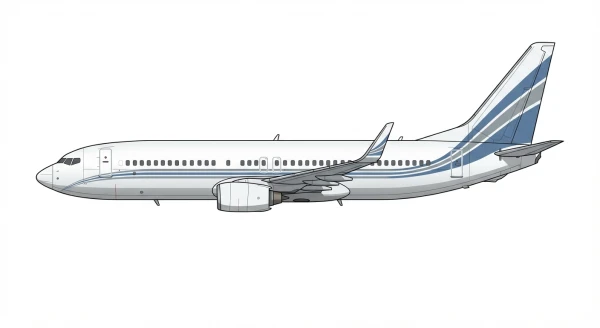
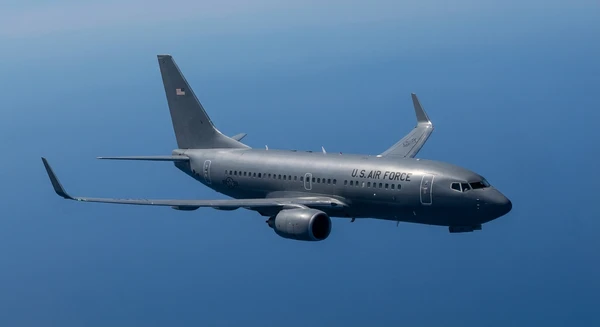
| Length | 30 m (98.4 ft) |
| Wingspan | 28 m (91.9 ft) |
| Height | 11 m (36.1 ft) |
| Wing area | 91 m² (979.5 sqft) |
| Empty weight | 29,071 kg (64,091 lbs) |
| Max. takeoff weight | 52,163 kg (115,000 lbs) |
| Powerplant | 2 × turbofans Pratt & Whitney JT8D-9A 6,577 kgf each |
| Maximum speed | 904 km/h (562 mph) |
| Operational range | 4,800 km (2,983 mi) |
| Service ceiling | 11,278 m (37,001 ft) |
-
 United States
19
United States
19
-
 Colombia
5
Colombia
5
-
 Indonesia
5
Indonesia
5
-
 Australia
2
Australia
2
-
 China
2
China
2
- 🇨🇩 Congo Democratic Republic 2
-
 Ecuador
2
Ecuador
2
-
 India
2
India
2
-
 Chile
1
Chile
1
-
 Peru
1
Peru
1
-
 Taiwan
1
Taiwan
1
-
 South Africa
1
South Africa
1
Description
The Boeing 737 is an American narrow-body twinjet built by Boeing in Washington state, developed as a short-haul airliner and subsequently adapted into military transport, training, maritime patrol and airborne early warning variants. It entered service with Lufthansa in February 1968 and has been produced in four generations — Original, Classic, Next Generation and MAX. It is the airframe underlying the T-43, C-40 Clipper, P-8 Poseidon and E-7 Wedgetail.
Development
Preliminary design began on 11 May 1964 around a 50–60 seat aircraft flying 50 to 1,000 miles. Joe Sutter moved the engines from the aft fuselage to the wings, permitting six-abreast seating and a low fuselage. Boeing reused 60% of the 727's structure and systems, including the 148-inch fuselage cross-section derived from the 707. The board authorised the $150 million programme on 1 February 1965; Lufthansa ordered 21 aircraft on 19 February 1965 and United 40 on 5 April 1965, the latter prompting the stretched -200. The 737-100 first flew on 9 April 1967 and was certified on 15 December 1967. Only 30 -100s were built. Sales collapsed in the early 1970s — 22 deliveries in 1972 — and USAF orders for the T-43 sustained the line. Fuselages are built by Spirit AeroSystems in Wichita, Kansas; final assembly runs on three lines at Renton and one at Everett from July 2026. As of July 2026, 17,507 have been ordered and 12,654 delivered.
Design
The 737 uses a hydro-mechanical flight control system, with pilot inputs transmitted by steel cables to hydraulic boosters. On total hydraulic or double engine failure the elevators and ailerons revert to servo-tab control, driven by cable and pilot muscle force alone. No fuel dump system is fitted; aircraft circle to burn fuel or land overweight. Classic, NG and MAX variants use CFM56 and LEAP-1B turbofans mounted ahead of the wing with accessories moved to the pod sides, producing the non-circular intake. The NG introduced a six-screen LCD cockpit; the MAX uses four 15.1-inch Rockwell Collins displays derived from the 787. Military sensor fits include the Northrop Grumman MESA array on the E-7 and Motorola SLAMMR side-looking radar on the Indonesian Surveiller. The 737-200 Unpaved Strip Kit added a nose-gear gravel deflector and engine vortex dissipators.
Armament
Armament is confined to the P-8 Poseidon, which carries torpedoes, Harpoon anti-ship missiles and other stores for anti-submarine and anti-surface warfare. It also deploys and monitors sonobuoys and operates with the MQ-4C Triton. The T-43, C-40, E-7 and BBJ variants are unarmed.
Operational History
Nineteen T-43s were delivered to Air Training Command at Mather AFB during 1973–74, with two more to the Colorado Air National Guard supporting USAF Academy navigation training; the type was retired in 2010. Indonesia received three 737-2X9 Surveillers between May 1982 and October 1983. E-7 export customers are Australia (six, Project Wedgetail), Turkey (four, Peace Eagle) and South Korea (four, Peace Eye). The C-40 serves the US Navy and Air Force and has been ordered by the Marine Corps. Brazil operated two 737-2N3s as VC-96s.
Variants
- T-43/CT-43A: 737-200 modified as a navigator trainer for the USAF, two later converted to executive transports and one to the NT-43A radar testbed.
- 737-2X9 Surveiller: Indonesian maritime patrol and transport variant fitted with SLAMMR radar.
- C-40 Clipper: Military version of the 737-700C convertible NG for US Navy, Air Force and Marine Corps transport.
- P-8 Poseidon: 737-800ERX-based anti-submarine and anti-surface warfare aircraft for the US Navy.
- E-7 Wedgetail: AEW&C conversion of the 737-700IGW with a dorsal MESA array.
Frequently Asked Questions
What type of aircraft is the Boeing 737?
What is the maximum speed of the Boeing 737?
What is the range of the Boeing 737?
When did the Boeing 737 first fly?
How many Boeing 737 have been built?
Which countries operate the Boeing 737?
How much does a Boeing 737 cost?
What is the service ceiling of the Boeing 737?
- AUG 302026 Updated Description updated
- AUG 52026 Updated Powerplant updated in a site-wide editorial pass
- JUL 272026 Updated Name updated
- APR 72026 Updated Sources and cross-references refreshed
- JAN 122026 Updated Range updated in a site-wide editorial pass