KC-130 Hercules
American military transport aircraft, noted for tactical refueling and cargo application, extensively operational during Cold War era and beyond. Key figures: top speed 670 km/h, range 5,250 km, service ceiling 8,534 m, max takeoff weight 79,379 kg, unit price $22M, built 124. In service with 18 air forces as of 2026 — United States (85), Saudi Arabia (9), Israel (7) and 15 others.
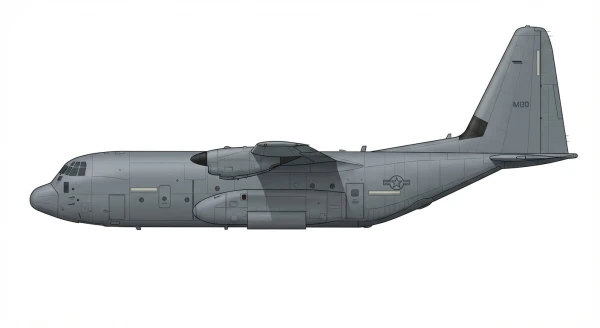
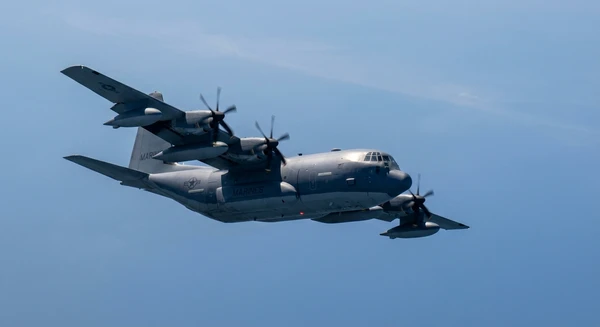
| Length | 29.8 m (97.9 ft) |
| Wingspan | 40.4 m (132.7 ft) |
| Height | 11.6 m (38.1 ft) |
| Wing area | 162 m² (1743.8 sqft) |
| Empty weight | 34,274 kg (75,561 lbs) |
| Max. takeoff weight | 79,379 kg (175,001 lbs) |
| Powerplant | 4 × turboprops Rolls-Royce AE 2100D3 4,474 kW each |
| Maximum speed | 670 km/h (416 mph) |
| Operational range | 5,250 km (3,262 mi) |
| Service ceiling | 8,534 m (27,999 ft) |
| Takeoff distance | 953 m (3,127 ft) |
-
 United States
85 +1
United States
85 +1
-
 Saudi Arabia
9
Saudi Arabia
9
-
 Israel
7
Israel
7
-
 Singapore
5
Singapore
5
-
 Canada
4
Canada
4
-
 Italy
4
Italy
4
-
 Malaysia
4
Malaysia
4
-
 Chile
3
Chile
3
-
 Germany
3
Germany
3
-
 Kuwait
3
Kuwait
3
-
 Argentina
2
Argentina
2
-
 France
2
France
2
-
 Japan
2
Japan
2
-
 Morocco
2
Morocco
2
-
 Peru
2
Peru
2
-
 Uruguay
2
Uruguay
2
-
 Indonesia
1
Indonesia
1
-
 Sweden
1
Sweden
1
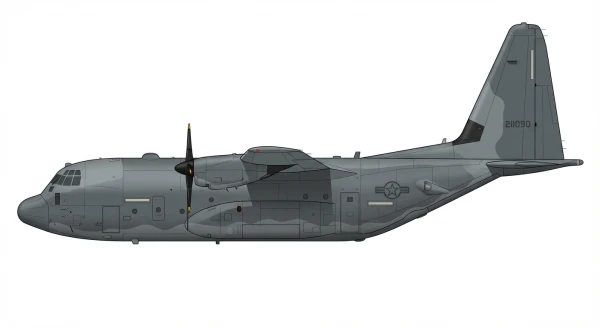
Description
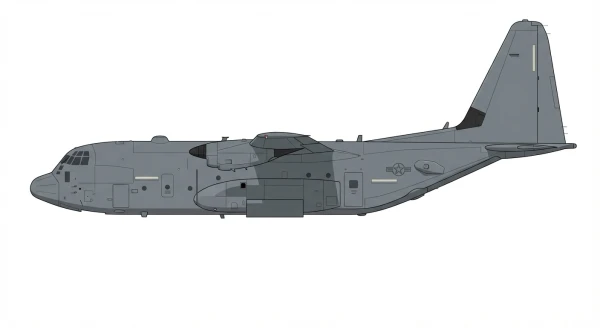
The KC-130 family emerged as an extended-range tanker version of the C-130 Hercules transport aircraft. The initial variant, KC-130F, conducted its first test flight in January 1960 under the designation GV-1. Entering service in 1962, the KC-130F was specifically designed to provide aerial refueling support for United States Marine Corps aircraft. It was developed from the Lockheed C-130 Hercules airframe. The KC-130J, based on the Lockheed Martin C-130J Super Hercules, while sharing 55% of its airframe with preceding models, offered considerable advancements in operational capability and performance margins when compared to the KC-130F/R/T variants.
Design
The KC-130 is designed as a multi-role, multi-mission tactical tanker/transport aircraft, primarily intended to provide refueling support for USMC aircraft. It offers in-flight refueling to both fixed-wing aircraft and helicopters within a 500-nautical-mile operating radius, and rapid ground refueling when required. It is also capable of aerial delivery of troops and cargo, emergency resupply into unimproved landing zones, emergency medical evacuation, tactical insertion of combat troops, and evacuation missions. The KC-130J variant boasts a fuel capacity of 27,215 kg, and an additional 11,064 kg can be offloaded from an internal fuselage aluminum fuel tank. The aircraft utilizes the standard probe and drogue technique, with two wing-mounted hose and drogue refueling pods capable of transferring up to 300 gallons per minute to two aircraft simultaneously.
Armament
The KC-130J primarily functions as a refueling platform, but it also offers a unique capability through the "Harvest HAWK" (Hercules Airborne Weapons Kit). This ISR / Weapon Mission Kit enables the aircraft to serve in an overwatch role, providing ground support fire with Hellfire or Griffin missiles, precision-guided bombs, and potentially 30mm cannon fire in future upgrades. The system integrates an AN/AAQ-30 Target Sight System (TSS), the same found on the AH-1Z Viper, mounting an infrared and television camera under the left wing's external fuel tank. A typical loadout comprises four Hellfire missiles and ten Griffin GPS-guided missiles, managed by a weapons systems operator via a Fire Control Console on an HCU-6/E pallet inside the cargo compartment. Importantly, the aircraft retains its original refueling and transport capabilities, and the entire Harvest HAWK system can be removed in under a day if required.
Operational History
The KC-130 has been utilized in numerous conflicts and operations over the last half-century, showcasing its versatility. These include the Vietnam War, Operation Desert Shield and Desert Storm, Operation Enduring Freedom, and Operation Iraqi Freedom, supporting USMC operations globally. Argentina also utilized the KC-130 during the Falklands War. VMGR-252 was the first squadron to transition to the KC-130J and sustained continuous fleet support during the transition. VMGR-252 marked the first operational combat deployment of the KC-130J to Al Asad, Iraq, in February 2005, supporting Operation Iraqi Freedom. During this deployment, the squadron achieved several milestones, including the first combat aerial delivery of supplies by any J model user, along with battlefield illumination, aerial refueling, and transportation of cargo and passengers. The aircraft's advanced defensive systems allowed it to operate closer to the battlefield, providing fuel to jets in close proximity to combat zones. Aircraft from VMGR-252 and VMGR-352 came under fire from insurgents during deployments to Iraq. Subsequently, a continuing KC-130J presence has been maintained in support of Operation Enduring Freedom in Afghanistan, along with deployments to Djibouti supporting counter-terrorist operations in the Horn of Africa.
Variants
Main Variants:
-
KC-130B: Six C-130B models were modified into in-flight refueling tankers.
-
KC-130F: This was an enhanced version of the KC-130B, with 46 aircraft built.
-
KC-130H: This is a tanker variant of the C-130H, with 33 built.
-
KC-130R: 14 former USAF aircraft transferred to the U.S. Marine Corps.
-
KC-130T: This variant is derived from the C-130H, with 28 having been built.
Frequently Asked Questions
What type of aircraft is the KC-130 Hercules?
What is the maximum speed of the KC-130 Hercules?
What is the range of the KC-130 Hercules?
When did the KC-130 Hercules first fly?
How many KC-130 Hercules have been built?
Which countries operate the KC-130 Hercules?
How much does a KC-130 Hercules cost?
What is the service ceiling of the KC-130 Hercules?
- APR 72026 Updated Sources and cross-references refreshed
- APR 62026 Updated Sources and cross-references refreshed
- JAN 122026 Updated KC-130 Hercules: range added; KC-130 Hercules: price added