M113
Summary
| Origin country | 🇺🇸 United States |
| Category | Armored Personnel Carrier |
| Sub-type | Armored Personnel Carrier |
| Manufacturer | FMC |
| Number built | 80000 units |
| Est. avg unit price | $0.6 million |
Technical specifications
| Crew | 2 personnels |
| Range | 480 km |
| Mass | 11.3 tons |
| Height | 1.85 m (6.1 ft) |
| Width | 2.7 m (8.9 ft) |
| Length | 2.52 m (8.3 ft) |
| Max. speed | 61 km/h (38 mph) |
| Engine | General Motors 6V53 Diesel Engine with 212 hp |
| Weapon 1 | 1 M2 HB 12.7mm machine gun |
| Weapon 2 | 1 M240 7.62mm machine gun |
Historical operators
Profile of M113
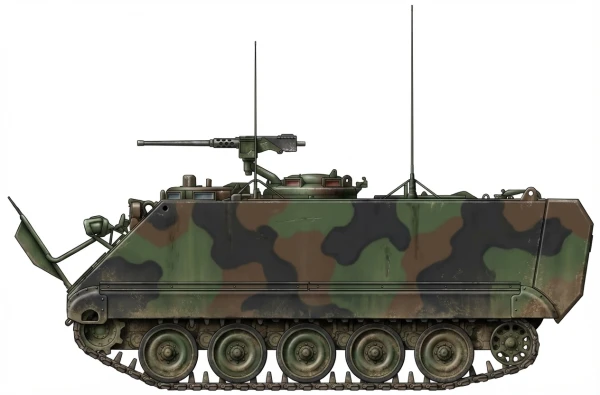
Description
The M113 is a fully tracked armored personnel carrier developed by the FMC Corporation to replace the M59 and M75 vehicles. It was designed to provide the protection level of the M75 with the weight and amphibious capabilities of the M59. FMC worked with Kaiser Aluminum to develop the 5083 aircraft-quality aluminum alloy armor used in the T113 prototype, which was selected for production over the steel T117. The vehicle entered service with the United States Army in 1960. The M113A1 variant, featuring a diesel engine to increase fuel economy and reduce fire hazards, entered production in 1964.
The aluminum hull provides protection against 7.62mm small arms fire and shell splinters. The M113 was the first aluminum-armored combat vehicle to enter mass production and was designed for air transport by C-130 and C-141 aircraft. The vehicle accommodates a crew of two and up to 15 passengers. The standard armament is a .50-caliber M2 Browning machine gun. During the Vietnam War, the Armored Cavalry Assault Vehicle (ACAV) kit was introduced, adding gun shields for the commander and side-mounted M60 machine guns. The M113A3 upgrade included the Reliability Improvements for Selected Equipment (RISE) package, consisting of a turbocharged engine, steering yoke, external fuel tanks, and internal spall liners. The chassis has been adapted for multiple roles, including the M577 command post, M106 mortar carrier, and M901 anti-tank vehicle.
Combat deployment began in 1962 with the South Vietnamese Army. During the Vietnam War, the M113 was used for reconnaissance in force and search and destroy missions, often operating in dense jungle terrain alongside M48 and M551 tanks. The Australian Army also deployed the vehicle in Vietnam, including fire support variants equipped with Saladin or Scorpion turrets. The Israel Defense Forces (IDF) became a major operator, utilizing the M113 in the Yom Kippur War, the 1982 Lebanon War, and operations in Gaza. Vulnerabilities to anti-tank weapons and improvised explosive devices in these conflicts led to the development of supplemental armor and replacement programs. The M113 has been widely exported and is used by several nations, including Brazil, Jordan, and the Philippines. Ukrainian forces have employed M113 variants during the Russo-Ukrainian War. The United States Army is currently replacing the vehicle in frontline units with the Armored Multi-Purpose Vehicle, while the IDF is transitioning to the Namer and Eitan platforms.