SA330 Puma
French medium-lift utility helicopter with extensive global service in troop transport since the late 1960s. Key figures: top speed 257 km/h, range 580 km, service ceiling 4,800 m, max takeoff weight 7,000 kg, unit price $2M, built 697. In service with 15 air forces as of 2026 — Romania (55), Pakistan (41), France (34) and 12 others.
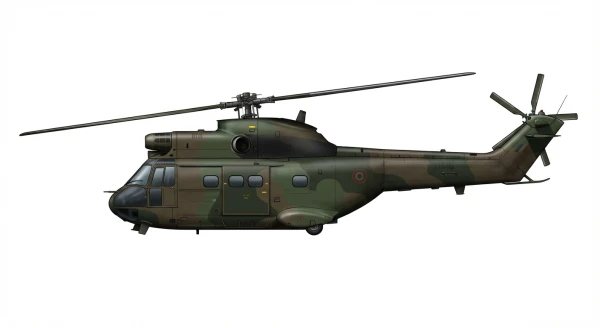
| Crew | 3 |
| Length | 18.2 m (59.5 ft) |
| Wingspan | 15 m (49.2 ft) |
| Height | 5.1 m (16.9 ft) |
| Empty weight | 3,536 kg (7,796 lbs) |
| Max. takeoff weight | 7,000 kg (15,432 lbs) |
| Powerplant | 2 × turboshafts Turbomeca Turmo IVC 1,175 kW each |
| Maximum speed | 257 km/h (160 mph) |
| Operational range | 580 km (360 mi) |
| Service ceiling | 4,800 m (15,748 ft) |
| Climb rate | 7.1 m/s (23.3 ft/s) |
-
 Romania
55
Romania
55
-
 Pakistan
41
Pakistan
41
-
 France
34
France
34
-
 Morocco
24
Morocco
24
- 🇨🇩 Congo Democratic Republic 10
-
 Indonesia
9
Indonesia
9
-
 Lebanon
7
Lebanon
7
-
 Kuwait
6
Kuwait
6
-
 Sudan
6
Sudan
6
-
 Gabon
5
Gabon
5
-
 Kenya
4
Kenya
4
-
 Chile
3
Chile
3
-
 Cameroon
2
Cameroon
2
-
 Guinea
2
Guinea
2
-
 Malawi
2
Malawi
2
-
 Ecuador
0
Ecuador
0
Recent Events — SA330 Puma
3 events →
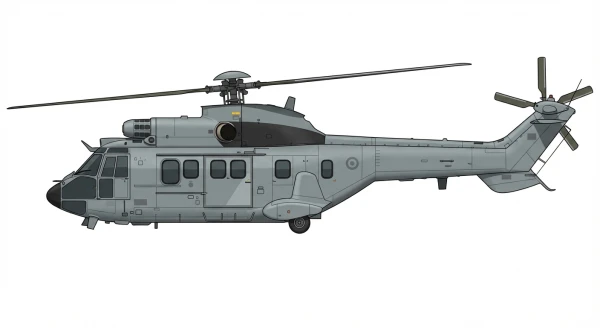
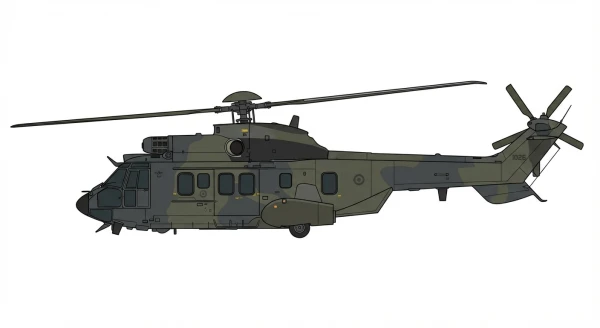
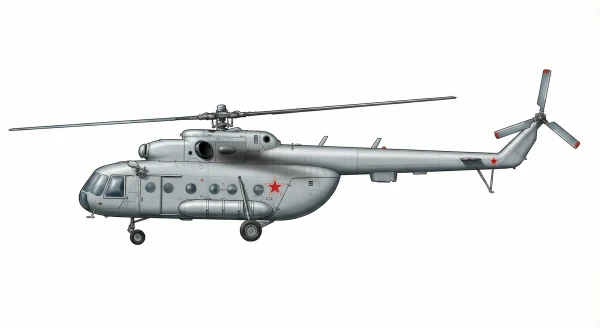
Description
The Aérospatiale SA 330 Puma is a twin-engined, four-bladed medium transport and utility helicopter designed by the French manufacturer Sud Aviation. Developed for a French Army requirement for an all-weather medium helicopter, it entered French Army service in early 1969 and became the best-selling European transport helicopter of the 1970s. It carries up to 16 troops, six litters with four attendants, or 2,500 kg of cargo internally or underslung.
Development
Work began in 1963 with French government backing. The first of two prototypes flew on 15 April 1965, followed by six pre-production aircraft, the last flying on 30 July 1968. One test aircraft was fitted with a large Fenestron, but production machines retained a conventional tail rotor. The first production SA 330 flew in September 1968. The RAF selected the type in 1967 as the Puma HC Mk 1, under a joint manufacturing agreement with Westland Helicopters, which built components and assembled RAF aircraft. Romania licence-produced at least 163 as the IAR 330; Indonesia's IPTN assembled 11. South Africa's Atlas Aircraft Corporation rebuilt its fleet as the Oryx, and Denel later derived the Rooivalk. Aérospatiale production ceased in 1987 after 697 sales; the AS332 Super Puma, first flown 13 September 1978, had overtaken it in output by 1980.
Design
Two roof-mounted Turbomeca Turmo turboshafts drive the four-blade main rotor through a five-stage transmission at 265 rpm. The design used single-part rotor shaft manufacture, anti-vibration measures in the gearbox and blades, and an automatic blade inspection system alerting crews to fatigue cracking. Two independent hydraulic systems separate flight controls from autopilot, undercarriage and rotor brake functions. Engine reserve power permits flight at maximum weight on one engine. The cockpit has dual controls plus a third seat, and a SFIM-Newmark Type 127 electro-hydraulic autopilot providing roll and pitch stabilisation, adjustable by the load hook operator. Rotor, landing gear and tailboom detach for transport by C-160 or C-130. Later fits include GPS, glass cockpits, infrared countermeasures, chaff/flare dispensers and the French Sitalat data link.
Armament
Armament fits include coaxial 7.62 mm machine guns and a side-firing 20 mm cannon. In 2013 the Lebanese Air Force converted an IAR 330 SM into the SA 330SM gunship with an ADEN Mk 4/5 30 mm revolver cannon and SNEB 68 mm rocket pods salvaged from Hawker Hunters; trials at Hamat Air Base on 10 October 2013 succeeded but the type was not adopted.
Operational History
Portugal was the first combat user, employing 12 aircraft in the Angolan and Mozambican wars. Five Argentine Army and one Coast Guard Pumas were lost in the 1982 Falklands War, including one to a Sea Dart from HMS Coventry on 9 May and two to Sea Harriers on 23 May. South African Pumas flew in the Border War from 1972, including Operations Savannah, Uric, Protea and Modular; 13 rescued 225 survivors from the MTS Oceanos in 1991. French Pumas served in Operation Barracuda (1979), the Gulf War, Bosnia, Kosovo, and Operation Barkhane from 2014. RAF Pumas operated in Iraq from 2003 to 2009 and retired on 31 March 2025.
Variants
- SA 330B: Initial French Army production version with 884 kW Turmo IIIC4 engines, 132 delivered.
- SA 330C: Initial export version powered by 1,044 kW Turmo IVB engines.
- SA 330H: French Army and export version with Turmo IVC engines and composite main rotor blades.
- SA 330L: Hot-and-high version, military equivalent of the civil SA 330J, designated CH-33 in Brazil.
- Puma HC Mk 2: 24 RAF aircraft upgraded with Makila 1A1 engines, glass cockpit and new self-protection equipment, in service from late 2012.
Frequently Asked Questions
What type of aircraft is the SA330 Puma?
What is the maximum speed of the SA330 Puma?
What is the range of the SA330 Puma?
When did the SA330 Puma first fly?
How many SA330 Puma have been built?
Which countries operate the SA330 Puma?
How much does a SA330 Puma cost?
What is the service ceiling of the SA330 Puma?
- AUG 302026 Updated Description updated
- AUG 262026 Updated French retirement of July 2026 added to the operational history
- AUG 52026 Updated Powerplant and thrust updated
- JUL 232026 Updated Sources and cross-references refreshed
- APR 72026 Updated Sources and cross-references refreshed
- OCT 222023 Updated Specifications and description reviewed