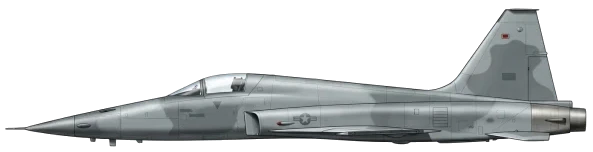
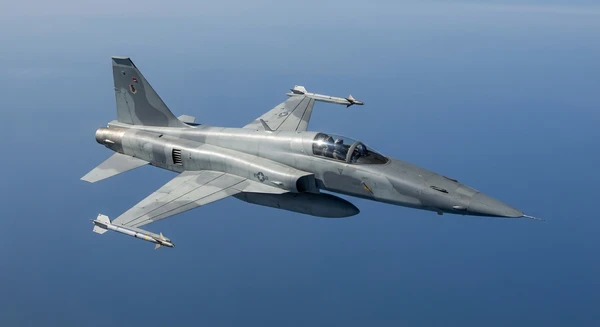
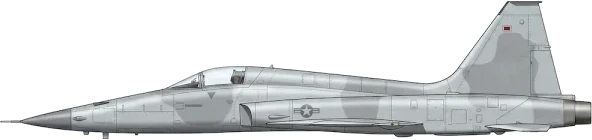
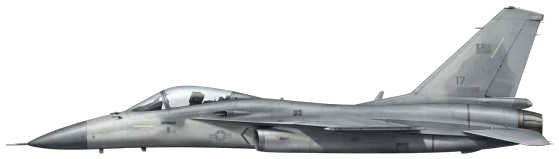
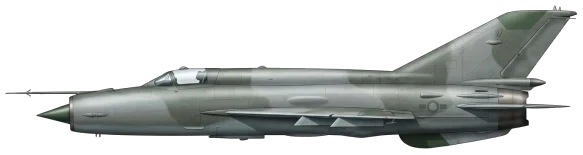
The Northrop F-5E Tiger II is a supersonic light fighter built by the Northrop Corporation in the United States as the second-generation development of the F-5A Freedom Fighter. Winner of the 1970 International Fighter Aircraft competition to arm American allies against the MiG-21, it first flew on 11 August 1972 and reached the US Air Force's 425th Tactical Fighter Squadron at Williams Air Force Base on 6 April 1973. Some 1,400 were built before production ended in 1987, and the type is known for its low purchase and operating cost, its wide export service in the day air superiority and ground-attack roles, and its long second career as a US Navy and Marine Corps adversary aircraft.
Development
The F-5 family began as a private Northrop venture after NATO's NBMR-1 requirement of December 1953 for a lightweight tactical fighter able to operate from rough airfields. Built around two compact General Electric J85 turbojets, the N-156 design produced the T-38 Talon trainer (1,189 built) and the N-156F fighter, which first flew at Edwards Air Force Base on 30 July 1959. Selected as the F-X export fighter on 23 April 1962, the F-5A Freedom Fighter ran to 624 single-seaters, 200 radar-less F-5B trainers and 86 RF-5As, plus 240 Canadair CF-5s and 70 CASA-built aircraft.
In 1970 Northrop won the International Fighter Aircraft competition with the F-5A-21, which became the F-5E. It introduced two J85-GE-21 engines, a lengthened fuselage carrying more fuel, enlarged leading-edge extensions and wing area for a better turn rate, and for the first time a radar, the Emerson Electric AN/APQ-153. The two-seat F-5F, with a nose 3 ft longer, a single M39 cannon and the AN/APQ-157 radar of about 10 nmi range, first flew on 25 September 1974, and the RF-5E Tigereye carried a sensor package in place of the radar and one gun. Northrop built 792 F-5Es, 146 F-5Fs and 12 RF-5Es; licence production added 91 in Switzerland, 68 by Korean Air in South Korea (KF-5E/F, from September 1982) and 308 by AIDC in Taiwan between 1973 and 1986. The single-engine F-5G, renamed F-20 Tigershark, lost its export bids to the F-16 in the 1980s.
Design
The F-5E is a small, all-metal, twin-engine fighter with a thin low-mounted wing of 17.3 m² (186 sq ft). It is 14.69 m (48 ft 2 in) long with a span of 8.13 m (26 ft 8 in), weighs 4,347 kg (9,583 lb) empty and 11,192 kg (24,675 lb) at maximum take-off, and carries 2,560 L (677 US gal) of internal fuel with provision for three 1,040 L (275 US gal) Sargent Fletcher drop tanks. The two General Electric J85-GE-21 afterburning turbojets each produce 15.6 kN (3,500 lbf) dry and 22.2 kN (5,000 lbf) in afterburner.
Performance figures are Mach 1.63 (1,739 km/h; 1,080 mph) at 11,000 m (36,000 ft), a service ceiling of 15,800 m (51,800 ft), an initial climb of 175 m/s (34,500 ft/min), a clean range of 891 km (554 mi), a ferry range of 3,720 km (2,310 mi) and a combat radius of 220 km (140 mi) with two Sidewinders and 2,400 kg (5,200 lb) of ordnance. The nose radar progressed from the AN/APQ-153 to the 20 nmi planar-array AN/APQ-159 in later production and the AN/APG-69 with mapping modes on US Navy F-5Ns.
Armament
Two 20 mm M39A2 revolver cannon with 280 rounds each sit in the nose of the F-5E; the F-5F keeps one. Seven stations — two wingtip missile rails, four underwing pylons and one centreline — carry up to 3,200 kg (7,000 lb). The original fit paired two AIM-9 Sidewinders on the wingtips with Mk 80-series bombs, CBU-24/49/52/58 cluster bombs, napalm, Paveway laser-guided bombs and LAU-61/68 Hydra 70, LAU-10 Zuni or SNEB rocket pods. Aircraft upgraded after 1995 added four AGM-65 Mavericks and up to four AIM-9s or AIM-120 AMRAAMs; Brazil's F-5EM carries the Derby and Python IV, Thailand's F-5TH the IRIS-T, Python-4 and Derby plus a centreline GPU-5/A 30 mm cannon pod.
Operational History
The F-5E never fought with the USAF but served from 1975 to 1990 as an aggressor with the 64th and 65th Squadrons at Nellis, the 527th at RAF Alconbury and the 26th at Clark. The Marine Corps bought ex-USAF aircraft for VMFT-401 at Yuma in 1989 and the Navy flew the type at TOPGUN and with VFC-13; 36 low-hour Swiss F-5E/Fs bought in 2006 became the F-5N/F fleet, and another 22 Swiss aircraft were handed over from 18 March 2024 under a $32.4 million sale.
Abroad the Tiger II has fought repeatedly. Ethiopian F-5Es of the 9th Fighter Squadron shot down two Somali MiG-21MFs near Harer on 17 July 1977 and claimed 13 MiG-17s and 12 MiG-21s with AIM-9 Sidewinders between 20 July and 1 September 1977 during the Ogaden War. Iran received 166 F-5E/Fs between 1974 and 1976 and flew them throughout the Iran–Iraq War; Israel reported destroying two at Dezful on 22 June 2025 and two more at Tabriz on 1 March 2026, and in April 2026 an Iranian F-5 bombed Camp Buehring in Kuwait. Morocco's 16 F-5Es and four F-5Fs, delivered 1981–83, flew bombing and reconnaissance sorties in the Western Sahara War, in which 15 F-5s of all versions were lost, several of them to Strela-2, SA-9 and SA-6 missiles and gunfire. Saudi F-5Es flew close air support over Kuwait in 1991, losing one to ground fire on 13 February; North Yemeni F-5Es claimed MiG-21s on 6 May and 20 June 1994.
Taiwan, at one time the largest operator with 336 F-5E/Fs, retired its last F-5Es in November 2023 and its F-5Fs and RF-5E Tigergazers in July 2025. Among the remaining operators, South Korea plans to retire its F-5s by 2027, Brazil is replacing its F-5EMs with the Gripen by 2029, and Switzerland, whose fleet peaked at 98 F-5Es and 12 F-5Fs in 1981, is replacing its F-5s with 36 F-35As.
Variants
- F-5E Tiger II: Single-seat fighter with two J85-GE-21s, AN/APQ-153 then AN/APQ-159 radar and two M39A2 cannon; 792 built by Northrop plus licence production abroad.
- F-5F Tiger II: Two-seat combat-capable trainer with a 3 ft longer nose, one M39A2 cannon and the AN/APQ-157 radar; first flown on 25 September 1974, 146 built.
- RF-5E Tigereye: Single-seat reconnaissance version with a sensor nose displacing the radar and one cannon, sold to Saudi Arabia and Malaysia; Taiwan converted seven F-5Es as Tigergazers.
- F-5N: Ex-Swiss F-5Es with the AN/APG-69 radar flown by the US Navy and Marine Corps as adversaries, being modernised with Garmin G3000 avionics as the F-5N+.
- F-5EM/F-5FM: Brazilian upgrade by Embraer and Elbit with Grifo-F radar, refuelling probe, helmet-mounted display and Derby and Python IV missiles, first delivered on 21 September 2005.
- F-5S/F-5T: Singapore's 1996–2001 rebuild with Grifo-F radar, enlarged leading-edge extensions and AIM-120 capability, the starboard cannon removed for avionics; retired in 2015.
- F-5TH Super Tigris: Royal Thai Air Force upgrade by Elbit and RV Connex with EL/M-2032 radar, glass cockpit, Link-T datalink and IRIS-T, Python-4 and Derby missiles.