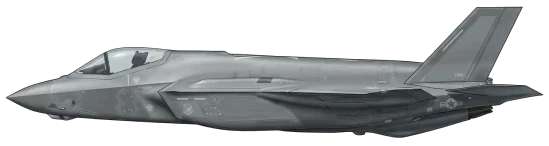
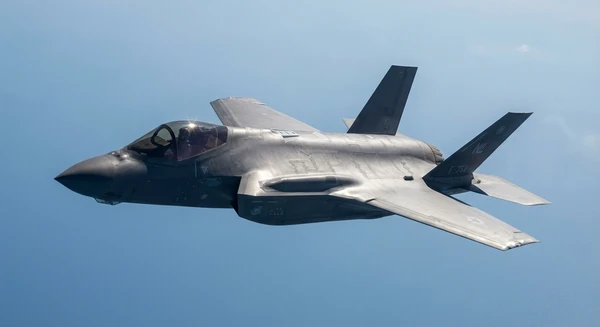
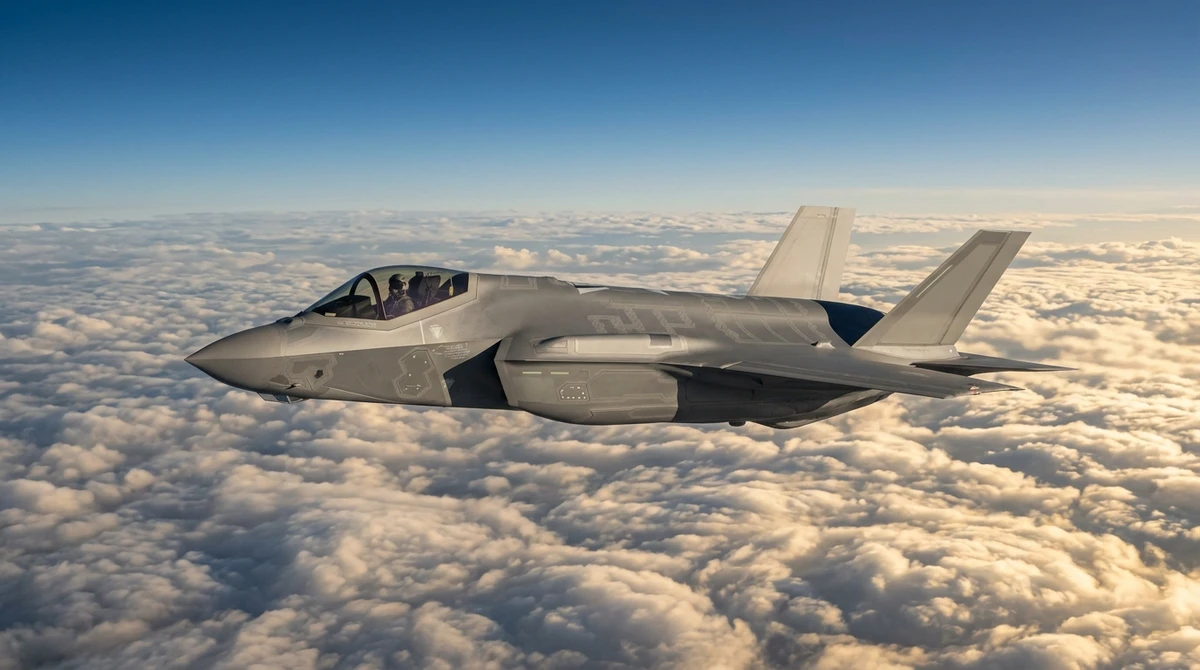
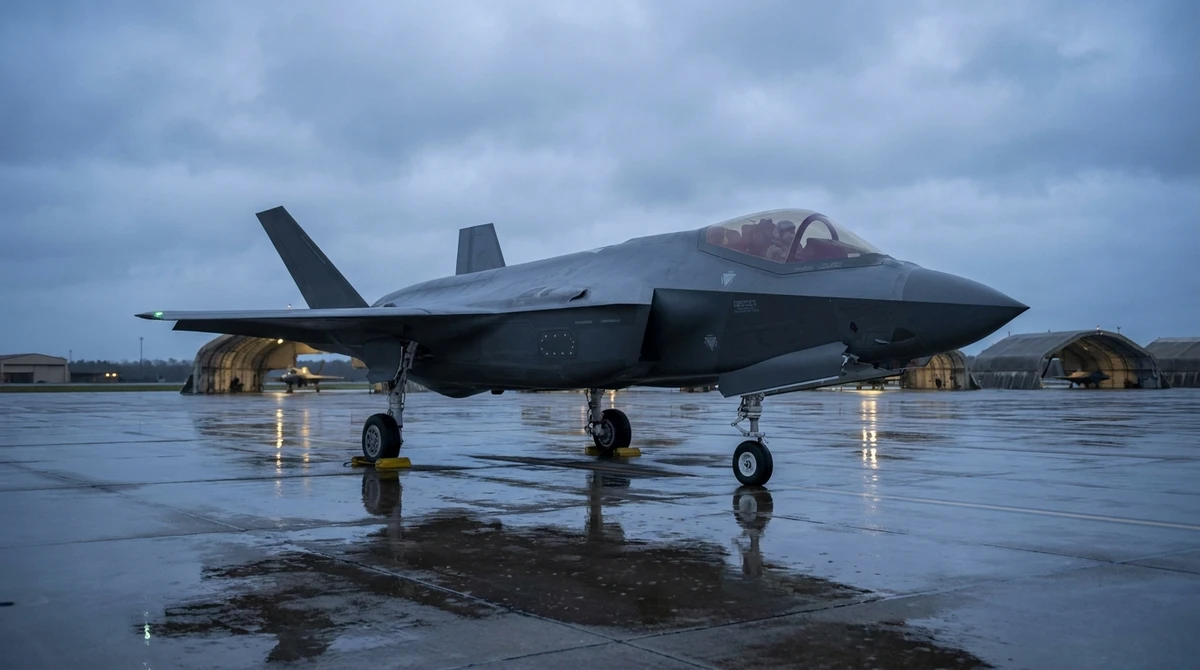
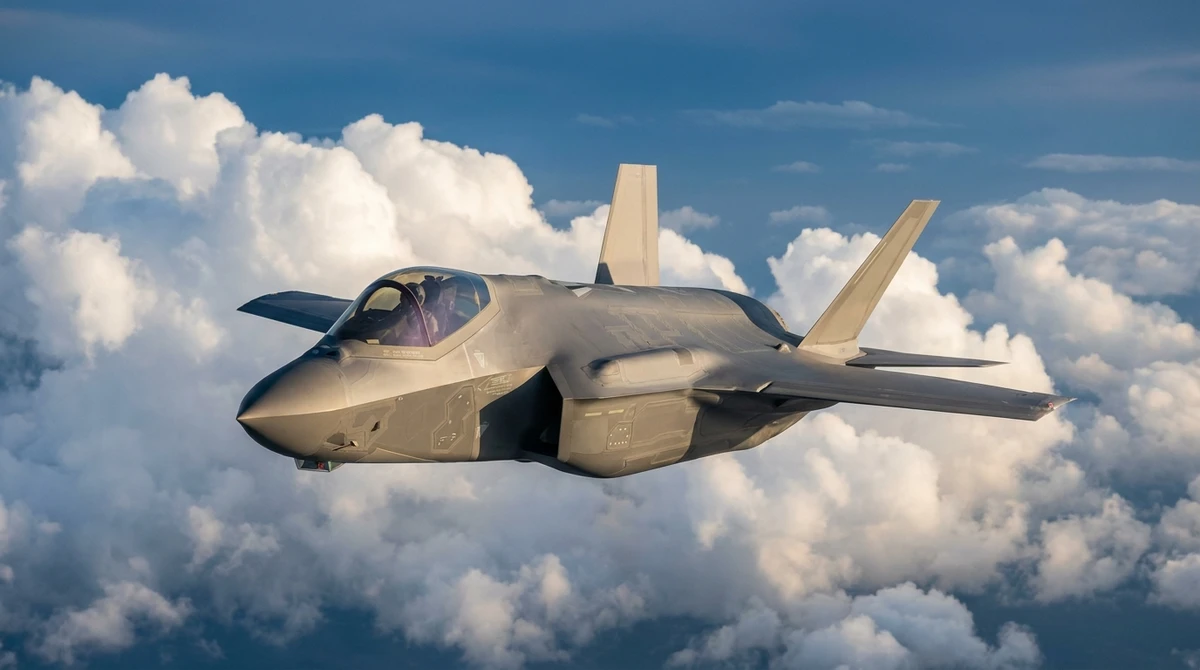
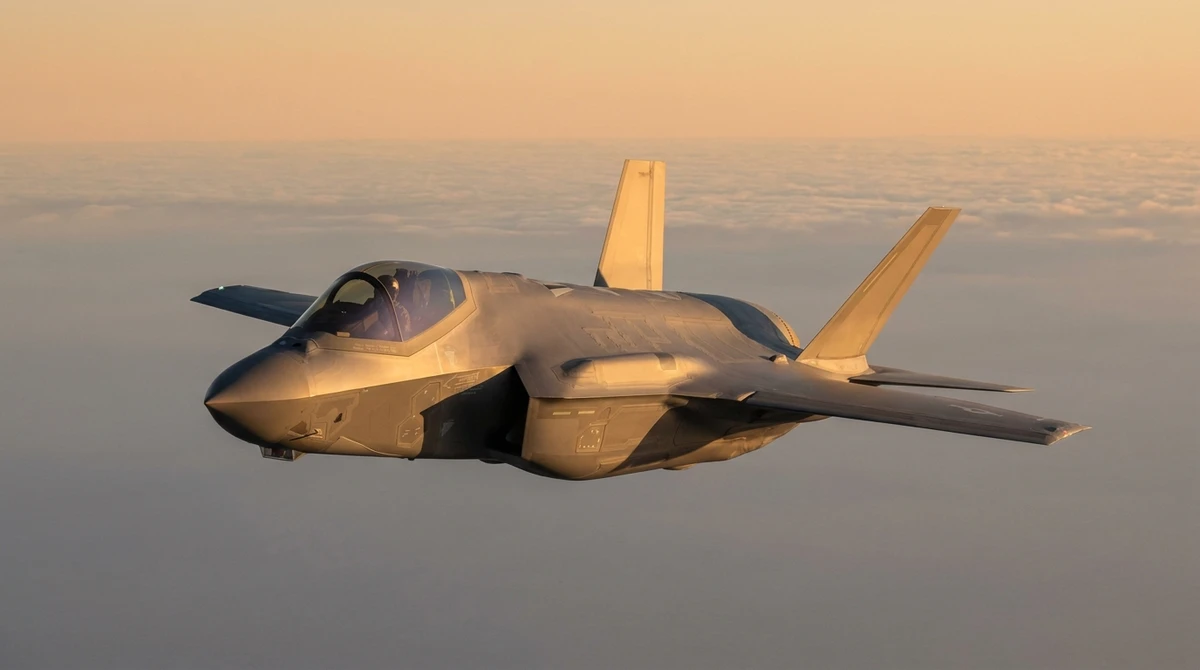
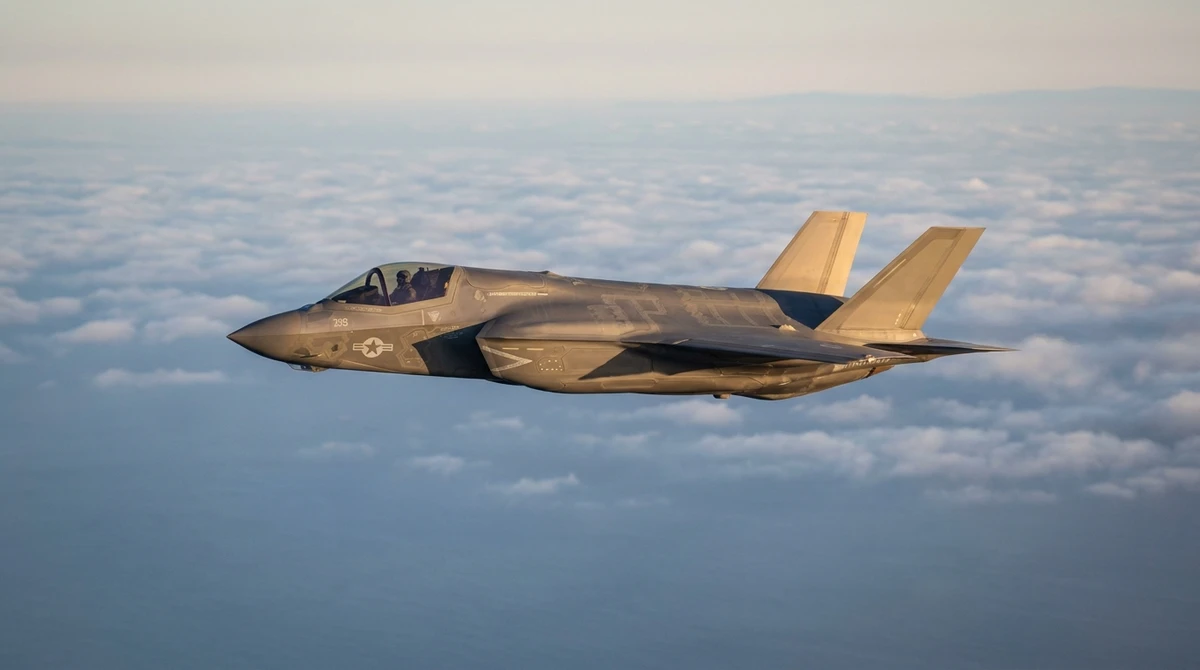
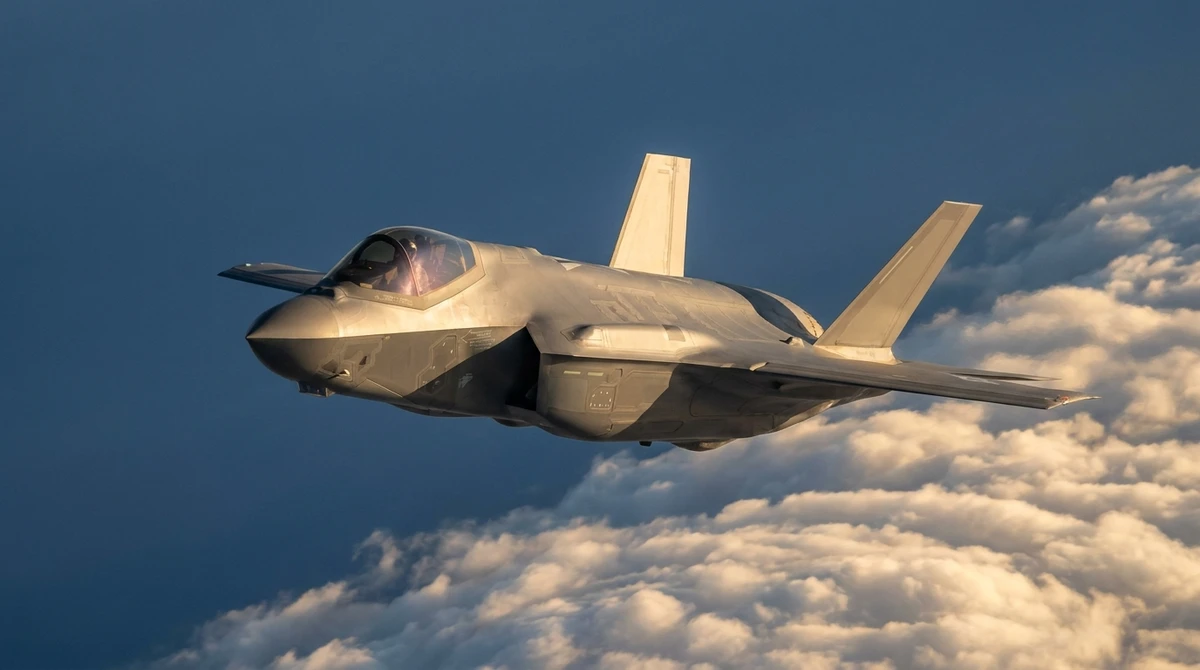
The Lockheed Martin F-35 Lightning II is an American family of single-seat, single-engine supersonic stealth multirole strike fighters, built by Lockheed Martin with Northrop Grumman and BAE Systems in three variants: the conventional take-off and landing F-35A, the short take-off and vertical landing F-35B and the carrier-based F-35C. Developed from the X-35 that won the Joint Strike Fighter (JSF) competition in 2001, it entered service with the US Marine Corps on 31 July 2015, the US Air Force on 2 August 2016 and the US Navy on 28 February 2019. It is the most numerous stealth aircraft in service, with 883 operational as of 2025 and more than 1,345 built by August 2026.
Development
The JSF programme, so named in 1995, merged DARPA's ASTOVL lift-fan research of 1983–1994 with the Joint Advanced Strike Technology effort formed in 1993 after the USAF Multi-Role Fighter and the Navy's A/F-X were cancelled. Eight partner nations led by the United Kingdom contributed $4.375 billion. Boeing's X-32 and Lockheed Martin's X-35 were selected for concept demonstration in 1997; the X-35A first flew on 24 October 2000 and was converted into the X-35B to demonstrate hover and vertical landing, and Lockheed Martin received the System Development and Demonstration contract on 26 October 2001.
Turning the demonstrator into a combat aircraft added about 1,000 kg (2,200 lb) to the F-35B, breaching every STOVL performance threshold; the weight-reduction effort begun in December 2003 cut more than 1,400 kg (3,000 lb) at a cost of $6.2 billion and an 18-month delay. The first F-35A, AA-1, flew at Fort Worth on 15 December 2006. Block 3F operational testing ran from December 2018 to late 2023, and the full-rate production decision came in March 2024, with the Fort Worth, Italian and Japanese assembly lines able to deliver 156 aircraft a year. The lifetime cost through 2088 was put at about $2 trillion in 2024; the Lot 18–19 flyaway cost of an F-35A is $92 million. The Block 4 upgrade on Technology Refresh 3 hardware began in 2019; TR-3 faults halted deliveries from July 2023 to July 2024, and in September 2025 the package was truncated, with engine-independent elements due by 2031 at the earliest. A June 2026 GAO report found full-mission-capable rates had fallen from 38% in fiscal 2021 to about 25% in fiscal 2025.
Design
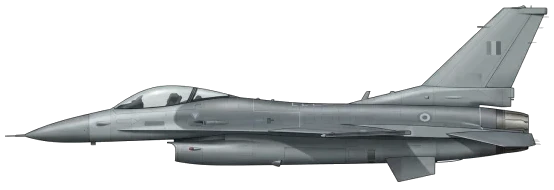
The F-35 has a wing-tail configuration with canted twin vertical stabilisers, leading-edge chines, diverterless supersonic inlets and an airframe 35% composite by weight. The F-35A weighs 13,290 kg (29,300 lb) empty and 29,900 kg (65,918 lb) at maximum take-off and carries 8,278 kg (18,250 lb) of internal fuel, more than double that of the F-16. All variants reach Mach 1.6 (1,960 km/h, 1,220 mph) with full internal payload. Radar cross-section is reduced by edge alignment, serrated panels and a radar-absorbent fibremat skin baked into the structure.
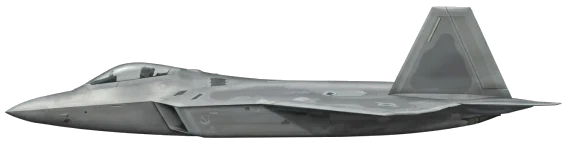
The Pratt & Whitney F135, derived from the F-22's F119, delivers 125 kN (28,000 lbf) dry and 191 kN (43,000 lbf) in afterburner. The F135-PW-600 of the F-35B drives the Rolls-Royce LiftSystem — a clutch-engaged lift fan, a three-bearing swivel nozzle and wing roll posts — in place of about a third of the A's fuel. Mission systems comprise the Northrop Grumman AN/APG-81 AESA radar with track-while-scan beyond 150 km (80 nmi), the AN/AAQ-37 Distributed Aperture System of six infrared sensors, the BAE Systems AN/ASQ-239 Barracuda electronic warfare suite, the AN/AAQ-40 Electro-Optical Targeting System and the AN/ASQ-242 communications suite with the directional MADL datalink and Link 16. The cockpit has a 50 × 20 cm (20 × 8 in) panoramic touchscreen, a right-hand side-stick and no head-up display: flight and targeting data appear on the helmet-mounted display.
Armament
Two internal bays each hold one station for an AIM-120 AMRAAM (the AIM-260 JATM later) and one 1,100 kg (2,500 lb) station — 680 kg (1,500 lb) on the F-35B — for JDAM, Paveway, AGM-154 JSOW or up to four GBU-39 Small Diameter Bombs. The F-35A was certified for the B61 Mod 12 nuclear bomb in October 2023. Six external stations, including canted wingtip rails for AIM-9X or AIM-132 ASRAAM, take weapons such as the AGM-158 JASSM and AGM-158C LRASM, for a total payload of 8,200 kg (18,000 lb). The F-35A mounts a 25 mm GAU-22/A cannon with 182 rounds in the left wing root; the B and C use a Terma centreline pod with 220 rounds.
Operational History
The USMC received its first F-35B for VMFA-121 at MCAS Yuma on 16 November 2012, declared initial operating capability on 31 July 2015 and flew the variant's first strike on 27 September 2018 from USS Essex against a Taliban target in Afghanistan. USAF F-35As reached IOC with the 34th Fighter Squadron at Hill AFB on 2 August 2016, deployed to Al Dhafra on 15 April 2019 and struck an Islamic State tunnel network in northern Iraq twelve days later; in 2025 they helped draw surface-to-air fire ahead of the B-2 strikes on Iranian nuclear sites; in January 2026 F-35s helped suppress Venezuelan air defences during the US strikes in Venezuela. Marine Corps F-35Cs struck Houthi targets in Yemen on 9 November 2024, the variant's first combat, and Navy F-35Cs of VFA-97 shot down Houthi drones over the Red Sea in April 2025.
The Israeli Air Force declared its F-35I Adir operational on 6 December 2017 and announced on 22 May 2018 that it had flown the type's first combat strikes anywhere. F-35Is shot down two Iranian drones on 15 March 2021, were reportedly involved in the October 2024 strikes on Iran, and flew in the June 2025 Twelve-Day War with low-observable conformal fuel tanks. From 28 February 2026 some 200 Israeli jets, F-35Is among them, struck about 500 Iranian targets; on 4 March 2026 an F-35I downed an Iranian Yak-130 over Tehran, the first claimed crewed kill by any F-35, and on 19 March 2026 a US F-35 damaged over Iran made an emergency landing, the type's first damage from enemy fire. Britain's No. 617 Squadron was declared combat-ready on 10 January 2019 and flew the RAF F-35B's first combat sortie over Iraq and Syria from Akrotiri on 25 June 2019. Germany's first aircraft was delivered on 18 September 2026, and Finland and Poland have begun taking deliveries, while Switzerland, Canada, Romania and Saudi Arabia (48 F-35As, potential sale approved by the State Department on 17 September 2026) are among the later customers. Twelve airframes had been lost in crashes by August 2026; the only fatal one was a JASDF F-35A on 9 April 2019.
Variants
- F-35A: Conventional take-off and landing variant for the USAF and most export customers, the lightest of the three, rated for 9 g, with the internal GAU-22/A and boom refuelling.
- F-35B: Short take-off and vertical landing variant with the shaft-driven lift fan, limited to 7 g, flown by the USMC, the UK, Italy and Japan from amphibious ships and carriers.
- F-35C: Carrier variant for catapult launch and arrested recovery with larger folding wings, enlarged control surfaces, a twin-wheel nose gear and reinforced landing gear, limited to 7.5 g.
- F-35I Adir: Israeli F-35A with locally built wings, Israeli electronic warfare systems layered over the baseline avionics and a dedicated testbed airframe for integrating national weapons.
- CF-35: Proposed Canadian variant with a drag chute and probe refuelling, dropped in favour of standard F-35As with a chute and the Sidekick six-missile rack.