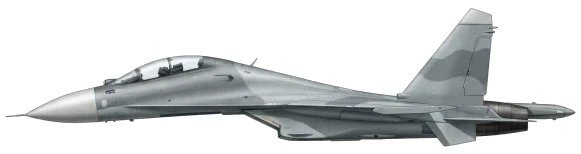
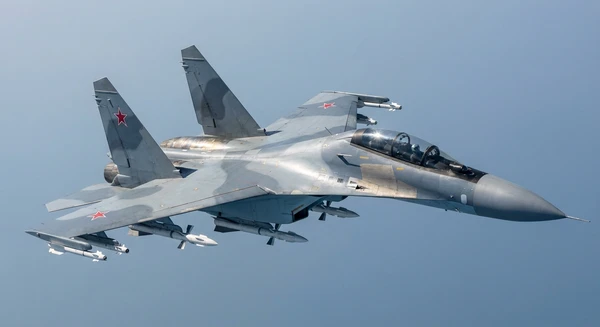
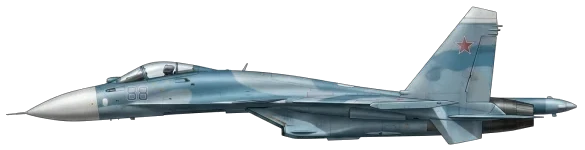
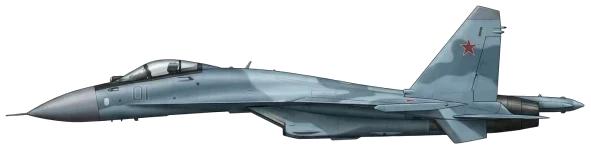
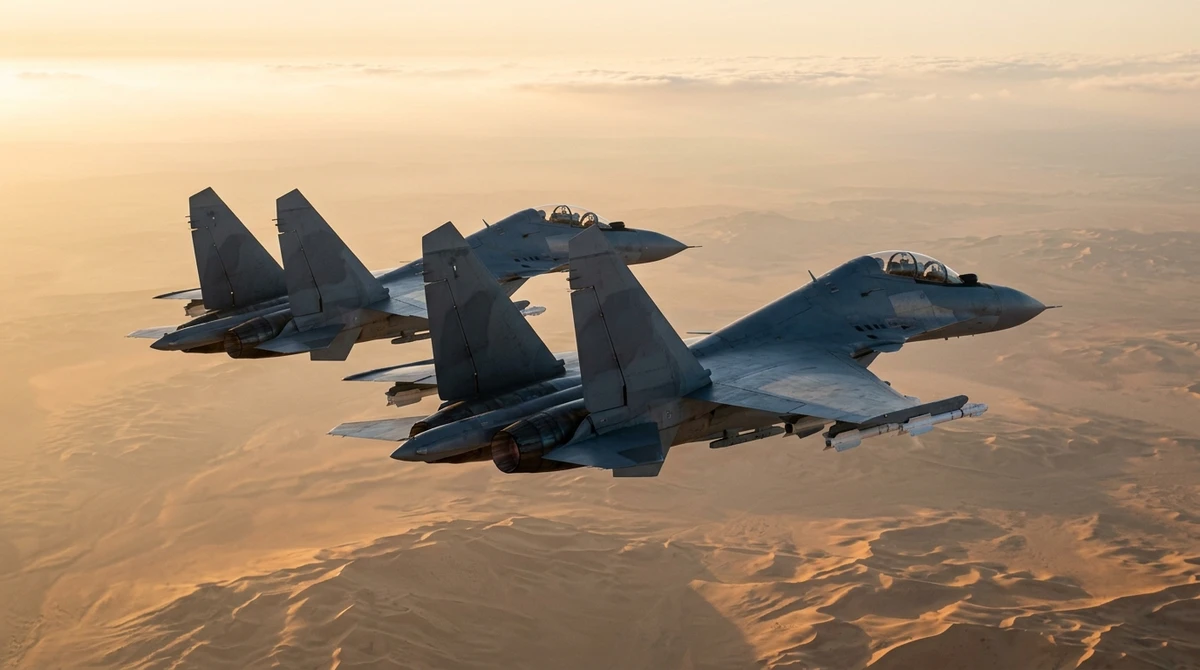
The Sukhoi Su-30 is a twin-engine, two-seat multirole fighter derived from the Su-27 Flanker, conceived in the late 1980s as a long-range interceptor for the Soviet Air Defence Forces and reborn in the 1990s as an export strike fighter. Built in two parallel lines at Irkutsk and Komsomolsk-on-Amur, more than 600 have been delivered to some fifteen air arms, India and Russia operating the largest fleets. Canard-equipped, thrust-vectoring versions (Su-30MKI, MKM, MKA, SM) and simpler strike versions (Su-30MKK, MK2) remain in service in 2026; the type has fought over Syria, Ukraine and Pakistan.
Development
The Soviet Air Defence Forces needed an interceptor able to cover the Soviet Union's vast airspace on long patrols and to direct other fighters as a command post. Development of the Su-27PU began in 1986 on the basis of the two-seat Su-27UB combat trainer; a demonstrator flew on 6 June 1987, the first prototype on 31 December 1989 at Irkutsk and the first pre-production aircraft on 14 April 1992. Five were delivered to Russia in 1994-96 as the Su-30, a designation formalised in 1996, and no further domestic orders of the basic version followed.
The programme survived on exports and split into two families. Irkut developed the Su-30MKI for India with canards, thrust-vectoring engines and a long-range phased-array radar; its descendants are the Malaysian MKM, the Algerian MKA and Russia's own Su-30SM. KnAAPO at Komsomolsk-on-Amur developed the Su-30MKK for China, a strike fighter without canards that drew on its Su-35 work, followed by the Su-30MK2 sold to China, Indonesia, Uganda, Venezuela and Vietnam.
Design
The Su-30 keeps the Su-27's blended airframe, twin tails and widely spaced engines, with a tandem cockpit and a dorsal airbrake behind the canopy. Two Saturn AL-31F-series afterburning turbofans deliver about 27,560 lbf (12,500 kgf) each; non-canard versions reach Mach 2 (2,125 km/h) at altitude. Range is 3,000 km (1,620 nmi) on internal fuel with a normal reserve, about 4.5 hours aloft; in-flight refuelling stretches that to 5,200 km or ten hours. Maximum take-off weight is 34,500 kg (76,000 lb).
The Irkut family adds canards and AL-31FP engines with canted thrust-vectoring nozzles, which with a digital fly-by-wire system gives the supermanoeuvrability the type is known for. The canards also offset the heavy N011M Bars radar in the nose and raise the angle-of-attack limit, at the cost of drag and a lower top speed. Radars vary by line: Bars on the Irkut versions, the Myech on the MKK and MK2, and the Su-35's Irbis-E on the Su-30SM2, with an OLS-30 infrared search-and-track sensor throughout.
Export avionics are multinational — Russian, Indian, French and Israeli systems on the MKI, Thales and South African equipment on the MKM — and the Su-30SM itself inherited French components, including a Thales head-up display, whose servicing became a problem under the sanctions that followed the 2022 invasion of Ukraine.
Upgrades
Russia's answer is the Su-30SM2, which fits the Irbis-E radar and the more powerful AL-41F1S engines of the Su-35S and adds the R-37M very-long-range missile; 21 were ordered for Naval Aviation in August 2020, and new-build aircraft now go to the Aerospace Forces and Belarus. India's "Super Sukhoi" programme is the family's most extensive mid-life upgrade: about 84 Su-30MKIs are to receive an active electronically scanned array radar, new cockpit, avionics and electronic-warfare suites and integration of the Astra missile, at an estimated $7.9 billion, keeping the fleet in service to around 2055. Malaysia funded a local upgrade after 14 of its 18 MKMs were grounded in 2018 for engine and spares problems.
Armament
A 30 mm GSh-30-1 cannon with 150 rounds is carried internally, and 12 hardpoints take up to 8,000 kg (17,600 lb) of stores. Air-to-air options are the R-27 family, the R-73 and the RVV-AE/R-77, plus the R-37M on the SM2. Strike weapons include the Kh-29 and Kh-59, the Kh-31 in anti-ship and anti-radar versions, KAB guided bombs, FAB general-purpose bombs, RBK-500 cluster bombs and S-8, S-13 and S-25 rockets. The Indian MKI adds the air-launched BrahMos cruise missile.
Operational History
Russia
The five original Su-30s served at Savasleyka. Impressed by the export MKI, Russia ordered a domestic version, the Su-30SM, under two 2012 contracts for 60 aircraft; deliveries began in November 2012 and 36 more, six for Naval Aviation, followed in 2016. The type deployed to Syria from September 2015, first escorting strike aircraft and bombers from Khmeimim and later flying ground attack itself; one crashed on take-off there in May 2018, killing both crew.
Since February 2022 the Su-30SM has flown air-superiority, strike and Black Sea patrol missions, sharing with the Su-35S at least seven confirmed air-to-air victories over Ukrainian jets; Russian sources credited a Su-30SM2 with an R-37M kill on a Su-27 in February 2025. Losses have been heavier: at least three shot down in the first weeks of the war, one destroyed on the ground at Millerovo, at least three destroyed in the Saky air base explosions of 9 August 2022, four reportedly hit by drones at Kursk in August 2023, and an aircraft downed over the Black Sea on 2 May 2025 by what Ukrainian intelligence described as an AIM-9X missile fired from a Magura naval drone, the first aircraft claimed by an unmanned surface vessel. Further Su-30SMs were lost over Crimea in October 2025, reportedly to friendly fire, and in April 2026, and damaged in drone strikes on Lipetsk and Vityazevo air bases.
India
India signed for eight Su-30Ks and 32 Su-30MKIs in November 1996 and, in December 2000, a licence to build 140 MKIs at Hindustan Aeronautics Limited (HAL) in Nashik, which took over production from Irkutsk in 2004. Follow-on orders from 2007, and 12 attrition replacements decided after the 2020 Ladakh clashes, brought the Indian Air Force to about 260 aircraft, the largest Su-30 fleet in the world; the Su-30Ks went back to Russia in 2007 and were resold to Angola and Ethiopia. In Operation Sindoor in May 2025 Su-30MKIs covered the strikes of 7 May and were reported to have hit Pakistani air bases with BrahMos missiles on 10 May; one MKI was lost on the night of 7 May, claimed by Pakistan; France's air force chief later said he had seen evidence of a Sukhoi loss, though India has not detailed the circumstances. Peacetime crashes followed in Madhya Pradesh in 2023, Nashik in 2024 and Assam in March 2026.
Export operators
China bought 76 Su-30MKKs under 1996 and 2001 agreements and 24 Su-30MK2s for its naval air arm in 2004. Algeria built the second-largest export fleet with 28 MKAs ordered in 2006, 16 more in exchange for rejected MiG-29s and a further 16 in 2019. Vietnam took Su-30MK2s in several batches from 2004, Malaysia 18 MKMs from 2007 and Venezuela 24 MK2s from 2006. Belarus signed for 12 Su-30SMs in 2017, received eight from 2019 and switched the remainder to Su-30SM2s, delivered in pairs from May 2025 to January 2026. Armenia's four Su-30SMs, bought without a missile package, played no part in the 2020 Nagorno-Karabakh war; Myanmar commissioned two more Su-30SMEs in March 2026.
Operators
As of 2026 the Su-30 serves with India (about 260 Su-30MKI), Russia (some 130 in the Aerospace Forces and around 30 in Naval Aviation), China (97 MKK/MK2), Algeria (about 70 MKA), Vietnam (35 MK2), Kazakhstan (29 SM), Venezuela (around 20 MK2), Malaysia (18 MKM), Belarus (16 SM/SM2), Angola (12 Su-30K), Indonesia (11 MK2), Uganda (6 MK2), Myanmar (Su-30SME), Armenia (4 SM) and Ethiopia (2 Su-30K, inducted in January 2024). In June 2026 Russian sources reported that Iran had agreed to buy 12 second-hand Su-30SM2s for delivery from 2027, without official confirmation.
Variants
- Su-30 (Su-27PU, Flanker-C): Original interceptor and airborne command post; five built.
- Su-30K: Export version of the basic Su-30; 18 delivered to India, returned and resold to Angola and Ethiopia.
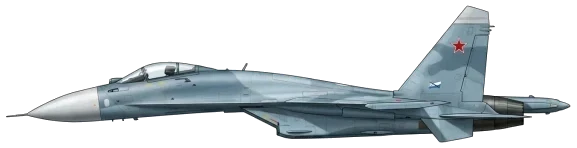
- Su-30MKI (Flanker-H): Irkut version for India with canards, AL-31FP thrust-vectoring engines and Bars radar; licence-built by HAL.
- Su-30MKA / Su-30MKM: Algerian and Malaysian MKI derivatives with different mission-system fits.
- Su-30SM: Russian serial version of the MKI line; Su-30SME is its export version with Russian-only avionics (Myanmar).
- Su-30SM2: Upgraded SM with Irbis-E radar and AL-41F1S engines; in production for Russia and Belarus.
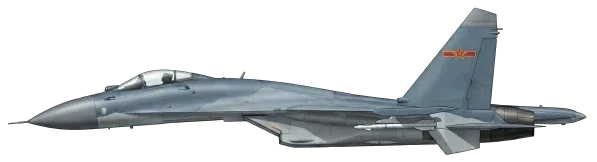
- Su-30MKK (Flanker-G): KnAAPO strike fighter for China without canards or thrust vectoring, Myech radar.
- Su-30MK2 (Flanker-G+): Improved MKK with anti-ship capability for China, Indonesia, Uganda, Venezuela (MK2 AMV) and Vietnam (MK2V); Su-30M2 is the Russian Air Force version.