Douglas DC-3
Summary
| Category | Military Transport Aircraft |
| Origin country | 🇺🇸 United States |
| Manufacturer | Douglas |
| First flight | 23 December 1941 |
| Year introduced | 1936 |
| Number produced | 10174 units |
| Average unit price | $0.1 million |
Technical specifications
| Version: Tri Turbo Three | |
|---|---|
| Operational range | 2,540 km (1,578 mi) |
| Maximum speed | 413 km/h (257 mph) |
| Wing area | 91.7 m² (987.0 sqft) |
| Wingspan | 29 m (95.1 ft) |
| Height | 5.6 m (18.2 ft) |
| Length | 22.7 m (74.5 ft) |
| Service ceiling | 7,071 m (23,199 ft) |
| Empty weight | 6,450 kg (14,220 lbs) |
| Max. takeoff weight | 13,154 kg (29,000 lbs) |
| Powerplant | 3 x turboprops Pratt & Whitney Canada PT6A-45 delivering 875 kW each |
Current operating countries
| Country | Units | ||
|---|---|---|---|

|
Thailand | 8 | |

|
Colombia | 6 | |

|
Mali | 1 | |

|
Mauritania | 1 | |

|
El Salvador | 1 | |
All operators
Description
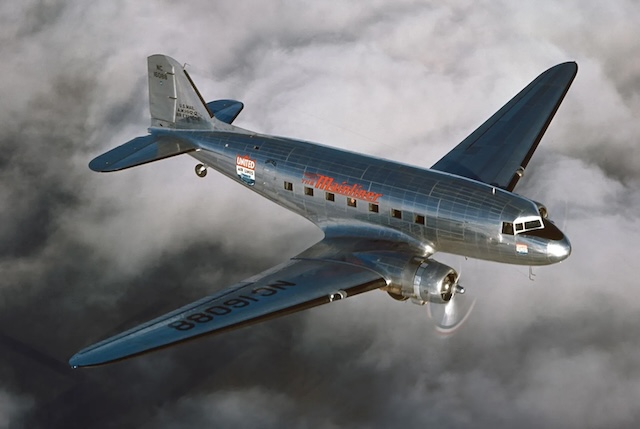
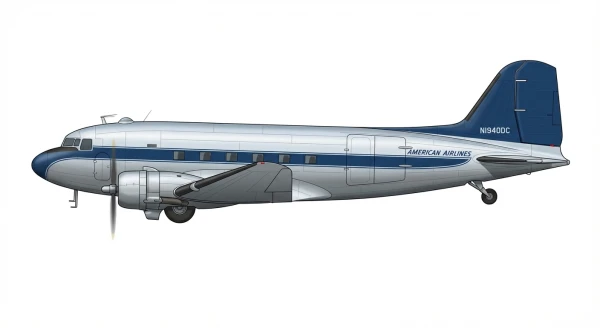
The DC-3 was the culmination of a development effort that began after Transcontinental and Western Airlines (TWA) requested a design to compete with United Airlines and their Boeing 247. Douglas' initial design resulted in the DC-2 in 1934. The DC-3 itself stemmed from a request by American Airlines CEO C. R. Smith, who persuaded Douglas to design a sleeper aircraft based on the DC-2. The new aircraft was engineered by a team led by chief engineer Arthur E. Raymond. The prototype DST (Douglas Sleeper Transport) first flew on December 17, 1935, with Douglas chief test pilot Carl Cover at the controls. The DC-3 enabled coast-to-coast flights in the United States in about 15 hours with three refueling stops.
The DC-3 is a low-wing metal monoplane distinguished by its conventional landing gear and powered by two radial piston engines producing between 1,000 and 1,200 hp (750–890 kW). Early production civilian aircraft used either the Wright R-1820 Cyclone 9 or the Pratt & Whitney R-1830 Twin Wasp engines, with later civil models favoring the R-1830. The aircraft has a cruising speed of 207 mph (333 km/h) and can carry 21 to 32 passengers or 6,000 lbs (2,700 kg) of cargo, with a range of 1,500 mi (2,400 km). It is capable of operating from short runways, and several radial engine options were offered during its production.
The Douglas DC-3 was primarily designed for passenger and cargo transport; offensive armament was not included in its original design. During military service, particularly as the C-47 Skytrain, it was adapted for various roles, including paratroop deployment and cargo transport.
American Airlines inaugurated passenger service on June 26, 1936, with simultaneous flights from Newark, New Jersey and Chicago, Illinois. Early U.S. airlines like American, United, TWA, Eastern, and Delta ordered over 400 DC-3s, which led to it eventually replacing trains as a common means of long-distance travel across the United States. During World War II, many civilian DC-3s were requisitioned for the war effort and more than 10,000 U.S. military versions were built, under the designations C-47, C-53, R4D, and Dakota, and used for the transport of troops, cargo, and wounded. Licensed copies were built in Japan as the Showa L2D and in the Soviet Union as the Lisunov Li-2. After the war, thousands of ex-military DC-3s became available for civilian use. The U.S. Navy had 100 of its early R4Ds converted to Super DC-3 standard during the early 1950s as the Douglas R4D-8/C-117D.
Main Variants:
-
DST (Douglas Sleeper Transport): The initial variant, it featured sleeper accommodation for up to 16 passengers and was powered by two 1,000–1,200-horsepower Wright R-1820 Cyclone engines.
-
DC-3: This was the initial non-sleeper variant, designed with 21 day-passenger seats and powered by 1,000–1,200 hp Wright R-1820 Cyclone engines.
-
DC-3A: An improved version of the DC-3, it utilized 1,000–1,200 hp Pratt & Whitney R-1830 Twin Wasp engines.
-
C-47 Skytrain: A military transport version of the DC-3A used extensively in World War II, it was adapted for cargo, troop transport, and paratrooper operations.
-
Super DC-3: A substantially redesigned DC-3 with a lengthened fuselage, modified wings, a taller tail, and more powerful Pratt & Whitney R-2000 or Wright R-1820 Cyclone engines, offering greater cargo capacity.