SA316 Alouette III
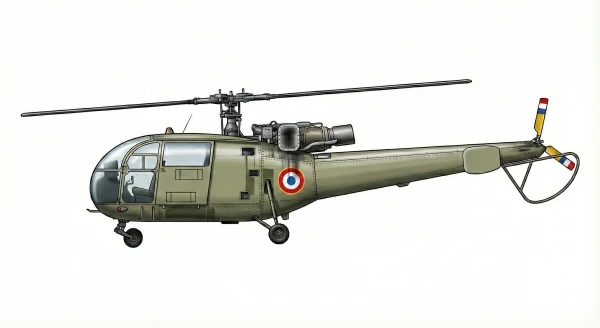
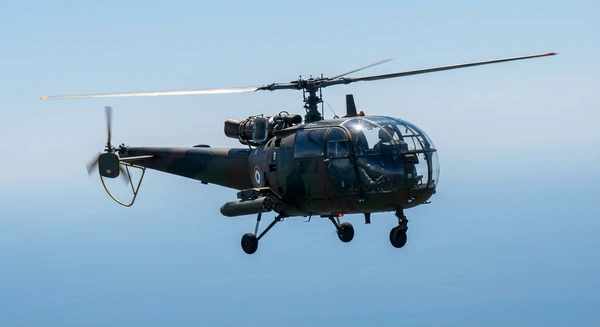
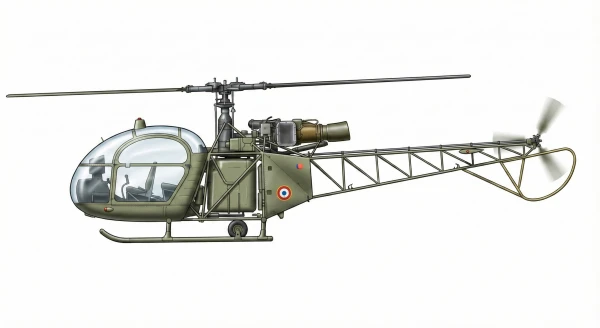
French utility helicopter, popular in the Cold War-era, extensively utilized for search and rescue, and light transport roles. Key figures: top speed 210 km/h, range 540 km, service ceiling 3,200 m, max takeoff weight 2,200 kg, unit price $1.5M, built 2,000. In service with 18 air forces as of 2026 — India (181), Pakistan (28), Angola (21) and 15 others.
| Crew | 1 |
| Length | 10.0 m (32.9 ft) |
| Wingspan | 11 m (36.1 ft) |
| Height | 3 m (9.8 ft) |
| Empty weight | 1,143 kg (2,520 lbs) |
| Max. takeoff weight | 2,200 kg (4,850 lbs) |
| Powerplant | 1 × turboshaft Turbomeca Artouste IIIB 713 kW each |
| Maximum speed | 210 km/h (130 mph) |
| Operational range | 540 km (336 mi) |
| Service ceiling | 3,200 m (10,499 ft) |
| Climb rate | 4.3 m/s (14.1 ft/s) |
-
 India
181
India
181
-
 Pakistan
28
Pakistan
28
-
 Angola
21
Angola
21
-
 Myanmar
13
Myanmar
13
-
 Zimbabwe
13
Zimbabwe
13
-
 Indonesia
7
Indonesia
7
-
 Romania
7
Romania
7
-
 Tunisia
7
Tunisia
7
-
 Burundi
3
Burundi
3
-
 Ethiopia
3
Ethiopia
3
-
 Namibia
3
Namibia
3
-
 Suriname
3
Suriname
3
- 🇸🇿 Eswatini 3
- 🇨🇩 Congo Democratic Republic 2
-
 Gabon
2
Gabon
2
-
 Bolivia
1
Bolivia
1
-
 Senegal
1
Senegal
1
-
 Chad
1
Chad
1
Description
The Aérospatiale SA 316 Alouette III is a single-engine light utility helicopter developed by Sud Aviation of France. Introduced in the early 1960s, it was used for observation, liaison, casualty evacuation, air-sea rescue, transport and training, and could be armed for anti-tank, anti-ship and fire-support work. More than 2,000 were built over six decades in France, India, Romania, Switzerland and the Netherlands.
Development
The Alouette III was developed as an enlarged derivative of the Alouette II, itself derived from the SE 3120 of 1953 and the first production turbine-powered helicopter when completed in April 1956. The design team, led by René Mouille, produced the SE 3160 with seating for up to seven or two stretchers, improved pilot visibility and a more streamlined fuselage. The first prototype flew on 28 February 1959 with Jean Boulet at the controls; it landed above 4,000 m in the Mont Blanc massif in June 1959 and above 6,000 m in the Himalayas in October 1960. Serial production began in 1961 and the type received its airworthiness certificate on 15 December 1961. The SE 3160 was replaced in 1968 by the SA 316B; the Astazou-powered variant first flew on 10 July 1967. The 1,437th French-built example left Marignane in 1979, with the last French delivery in 1985. Over 500 more were built abroad, including 250 IAR 316 in Romania between 1971 and 1987 and over 350 HAL Chetak in India, the latest delivered in 2021.
Design
The Alouette III used a three-blade main rotor of 11.02 m diameter and a glazed cabin seating a crew of two and five passengers. The SE 3160 and SA 316B were powered by a Turbomeca Artouste IIIB rated at 858 hp but de-rated to 563 hp by gearbox limits; the SA 319B substituted the Turbomeca Astazou XIVB for greater fuel efficiency, range and endurance. Empty weight was 1,143 kg and gross weight 2,200 kg, with a maximum speed of 210 km/h, range of 540 km and service ceiling of 3,200 m. Chilean naval aircraft carried radar for shipborne operations, and civil examples were fitted with external stretcher panniers, spray gear or cargo slings.
Armament
Armament options included Nord AS.11 MCLOS wire-guided anti-tank missiles — the first helicopter-launched anti-tank missiles in French service — AS.12 missiles, unguided rockets, depth charges and a light anti-submarine torpedo. Portuguese helicanhão aircraft mounted an MG 151 20 mm autocannon firing from the left side door, while Rhodesian G-Cars carried two .303 Browning or a single 7.62 mm MAG machine gun.
Operational History
Portugal was the first operator to use the type in combat, from 1963 in Angola, Mozambique and Portuguese Guinea, flying air assaults with five or six transport canibais covered by one lobo mau gun-ship. The Rhodesian Air Force's No. 7 Squadron operated up to 34 Alouette IIIs as the core of its Fireforce doctrine. South Africa acquired 121 between 1962 and 1975 and lost eight during the Border War, accumulating over 346,000 flight hours before retirement in June 2006. On 13 August 1983 a Republic of Korea Navy Alouette III sank a North Korean spy vessel with an AS.12 missile. The Irish Air Corps flew eight from 1963 to 2007, logging 77,000 hours, 1,717 search-and-rescue sorties and 542 lives saved. Argentine, Pakistani, Indonesian and Indian aircraft saw combat in the Falklands, the 1971 Indo-Pakistani War, East Timor and Operation Khukri. The French Navy withdrew its last examples in June 2022.
Variants
- SE 3160: First production version, 2,100 kg maximum weight, Artouste IIIB or IIIB1 engine.
- SA 316B: Strengthened main and tail rotors, 2,200 kg maximum weight and 590 hp takeoff rating.
- SA 319B: Turbomeca Astazou XIVB engine, 2,250 kg maximum weight.
- HAL Chetak: Indian licence-built SA 316B; the Chetan sub-variant used the TM 333-2M2 Shakti engine.
- IAR 316: Romanian licence-built SA 316B, basis for the IAR 317 Airfox gunship prototypes.
Frequently Asked Questions
What type of aircraft is the SA316 Alouette III?
What is the maximum speed of the SA316 Alouette III?
What is the range of the SA316 Alouette III?
When did the SA316 Alouette III first fly?
How many SA316 Alouette III have been built?
Which countries operate the SA316 Alouette III?
How much does a SA316 Alouette III cost?
What is the service ceiling of the SA316 Alouette III?
- AUG 302026 Updated Description updated
- AUG 52026 Updated Powerplant updated in a site-wide editorial pass
- APR 72026 Updated Sources and cross-references refreshed
- FEB 72026 Updated Range added
- OCT 222023 Updated Specifications and description reviewed